Tipping to Fly
safely flying tipped wheelchairs
Tipping to Fly
safely flying tipped wheelchairs
Padded Tipping Plate (PTP)
Technology Summary
Click below to learn more about the PTP and how it improves air travel accessibility
A new technology has now been designed and tested that enables powered wheelchairs to be safely tipped and maneuvered for air travel on Boeing 737 aircraft.
Padded Tipping Plate™
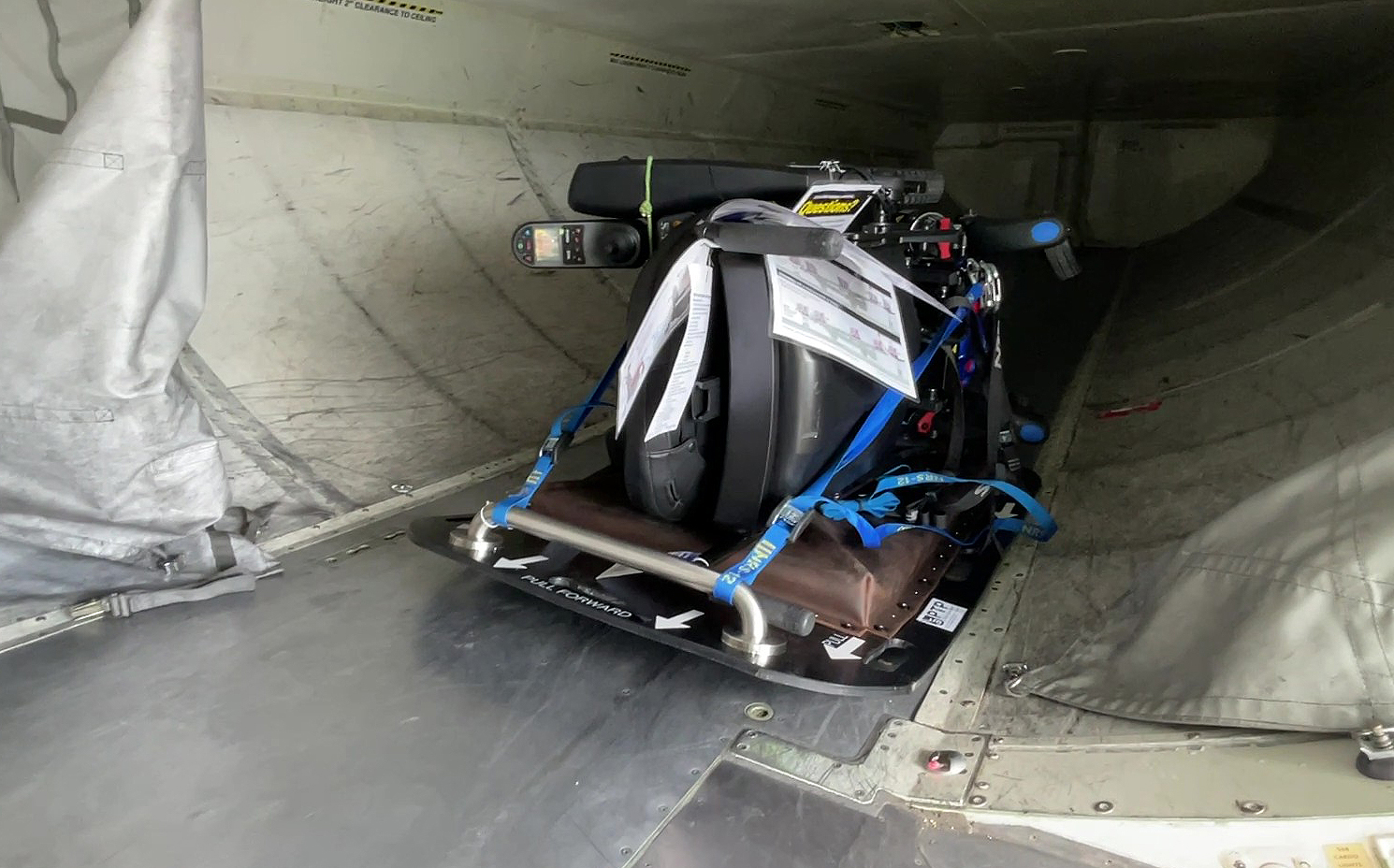
A powered wheelchair may now be secured to a new technology that enables safe tipping and transport of wheelchairs that are too tall to fit into aircraft cargo holds when positioned upright. Rigorous drop testing of heavy wheelchairs secured to a Padded Tipping Plate™ in the tipped configuration has been performed in a wheelchair testing laboratory. A 440 lb. powered wheelchair was also successfully secured to a Padded Tipping Plate™, tipped for loading, and transported on several 737 flight segments. The protected wheelchair was also transported while in the upright position on an Airbus flight as well.
the challenge
Powered wheelchairs provide essential mobility for many people across the world. Such devices are custom designed for the health and safety of the user and can often exceed the price of a car. Without one’s personal wheelchair, many people are immobile and in danger of serious, life-threatening injury. A powered wheelchair is an expensive, heavy (typically 300–450 lb), essential medical device that requires great care in handling and transport.
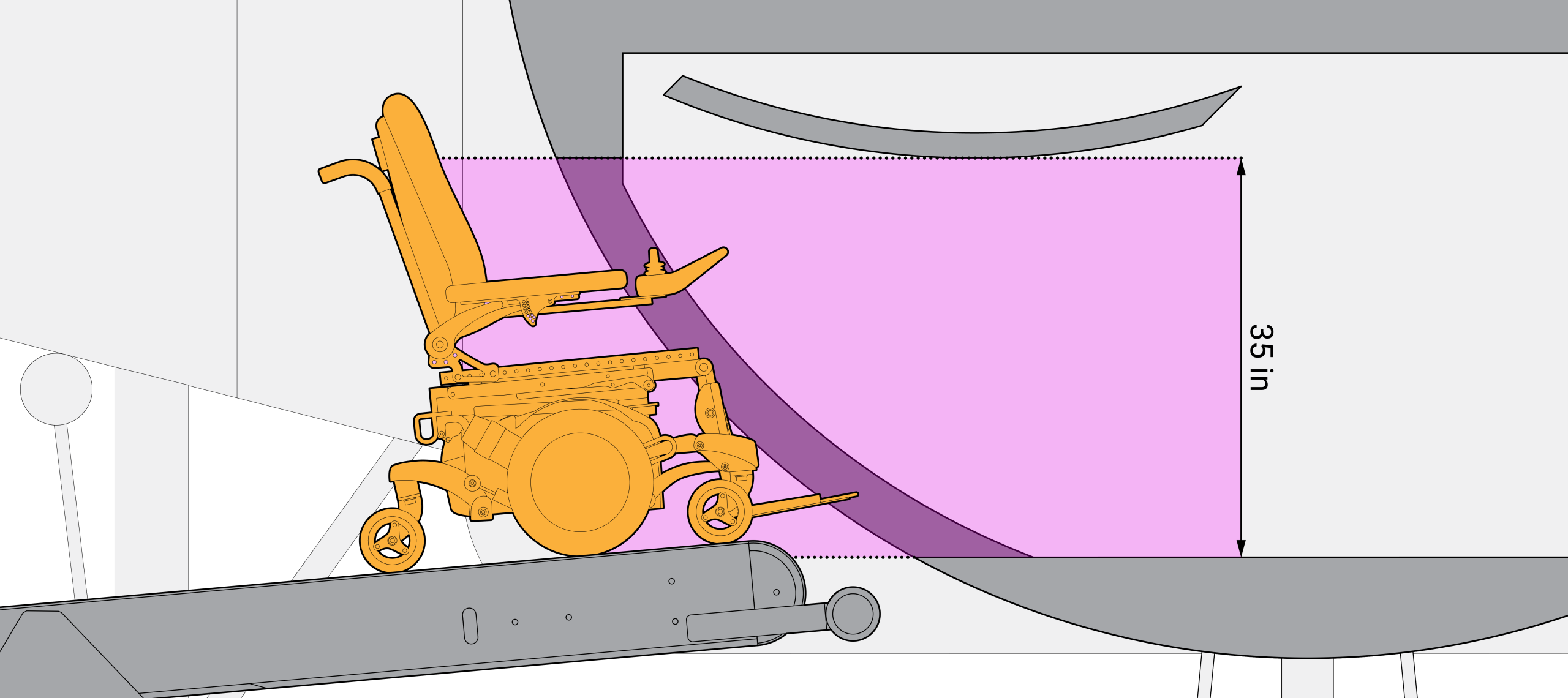
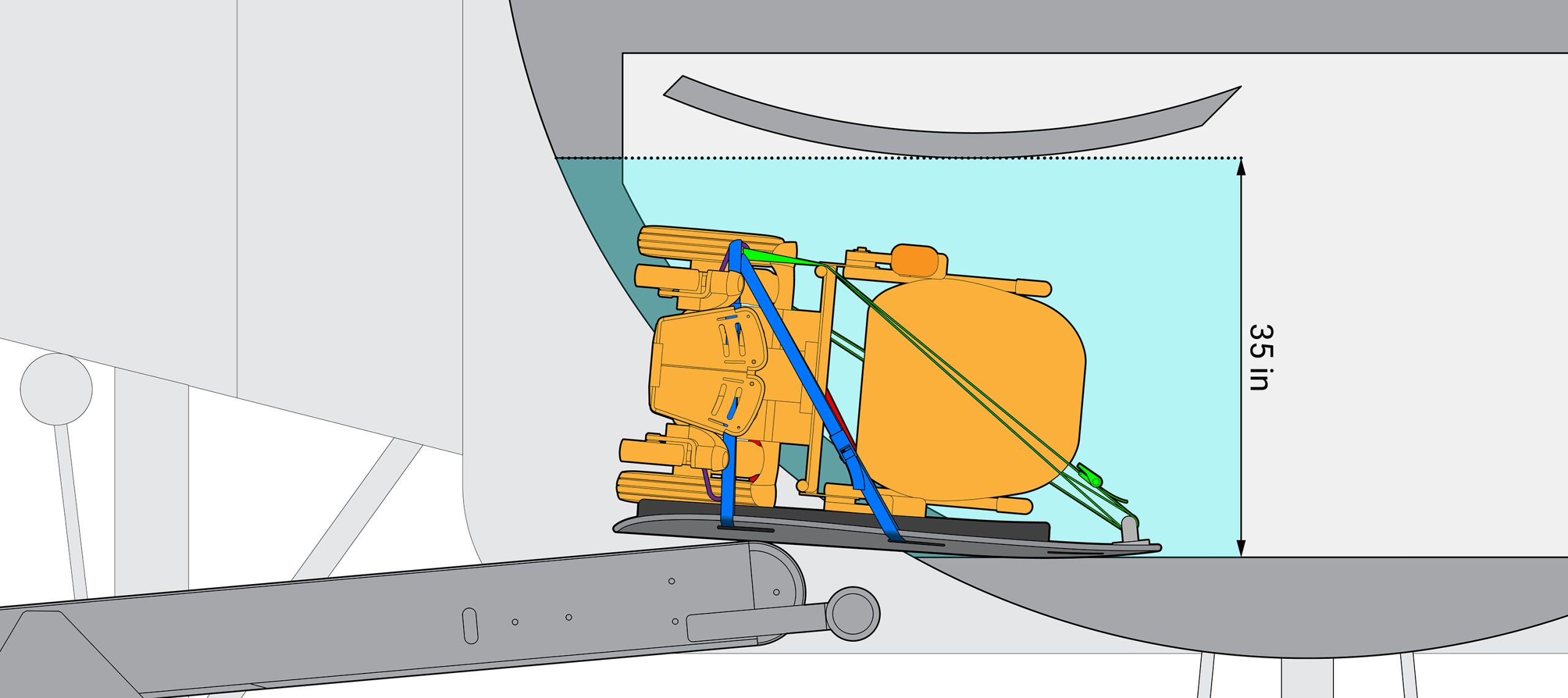
However, most powered wheelchairs will not fit into many aircraft cargo holds while upright. For example, the popular Boeing 737, which comprises a large percentage of the global aircraft fleet, is designed with a cargo door that provides only 35 inches of vertical clearance, which may be further reduced by airline working clearance policies. This presents a problem for both air carriers and passengers who must travel with their wheelchair. Since most powered wheelchairs are taller than 35 inches, they must be tipped on their side to be maneuvered into 737 cargo holds. This is essentially like trying to position a car by holding onto the body of the car, instead of the frame underneath. Additionally, such tipping has to occur on a narrow belt loader raised above the ground, from which the heavy, tipped device must transition the large gap between the belt loader and the floor of the aircraft.

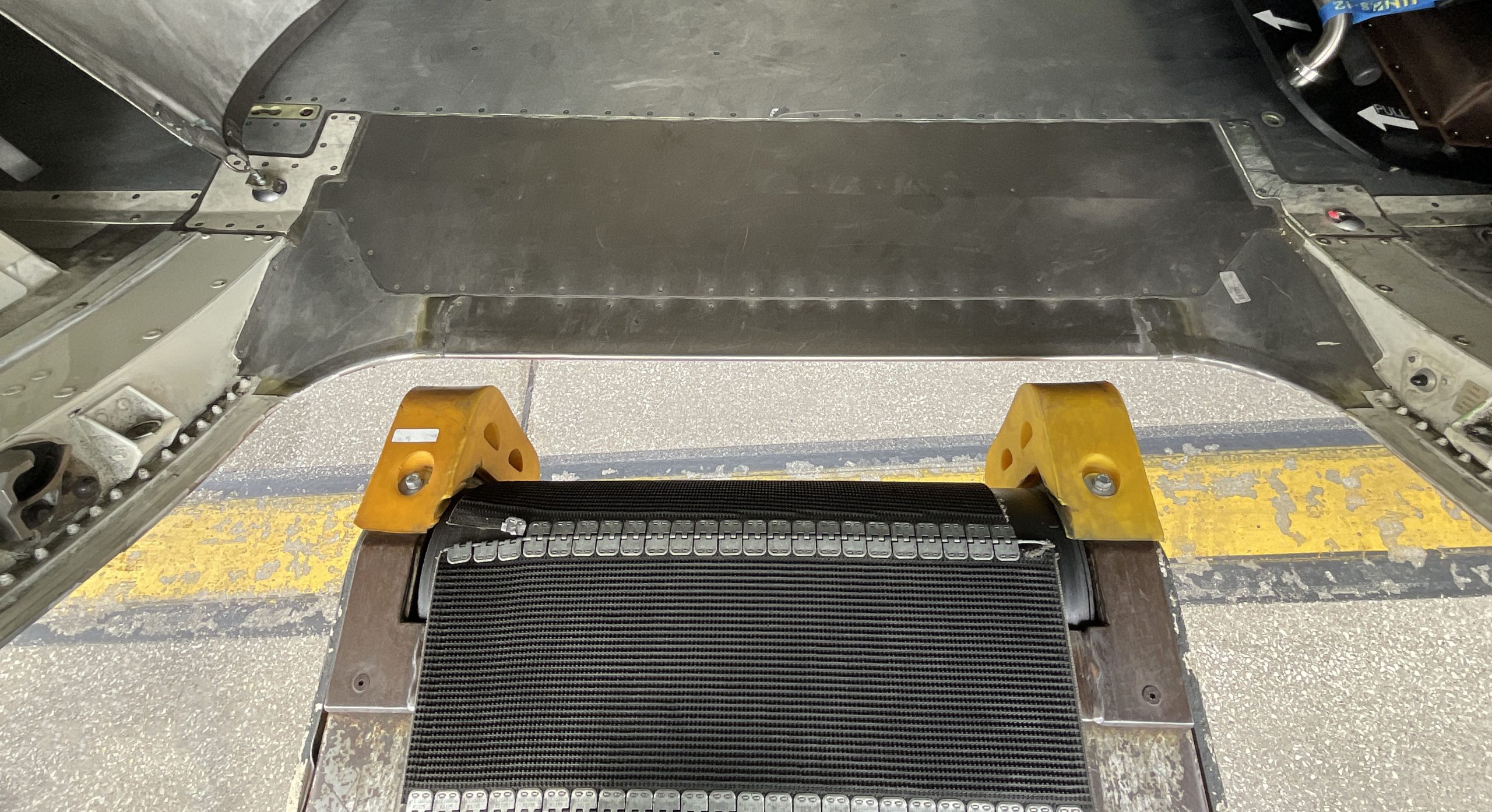
Decades of performing such procedures has resulted in damage to wheelchairs, as well as subsequent injury to the wheelchair user when their wheelchair is no longer available for use, and heavy financial burdens for the air carriers to repair or replace the wheelchair.
Due to the risks and liability involved in such a process, airlines are reluctant to tip heavy powered wheelchairs. Southwest Airlines, which only operates Boeing 737 aircraft, is now denying the transport of any powered wheelchair that cannot reduce to an upright height of 33 inches. While understandable, most powered wheelchair users are now effectively unable to travel on Southwest Airlines due to the airline’s inability to safely handle wheelchairs in and out of their 737 aircraft. However, restricting air travel only to passengers whose powered wheelchairs can fit through a cargo door when sitting upright will significantly reduce the number of available flights and destinations. Providing equal access to people with disabilities while protecting their wheelchairs requires a simplified handling procedure to load and unload powered wheelchairs in a tipped position.
existing procedures
Existing procedures for loading powered wheelchairs into aircraft such as the Boeing 737 have not significantly changed over the past 40 years. Typically, either four ground crew agents must manually lift the typically 300–450 powered wheelchair onto the belt loader or the device is transferred using a mechanical lift. Once the wheelchair is positioned on the belt loader, the tires of the upright powered wheelchair sit on the belt and are often wider than the belt itself. When the belt starts moving, this configuration can cause the wheelchair to twist and fall off the belt loader, destroying the expensive medical device. At the top of the belt loader, the wheelchair is then tipped on its side so that it will fit through the cargo door. The wheelchair is then maneuvered across the gap between the belt loader and cargo door and into the cargo hold. Tipping the device without any protection exposes weaker components to significant loads and may cause such components to be caught on nearby structures. The wheelchair may also potentially fall between the gap between the belt loader and cargo door. As a result, ground crews are currently forced to risk their own safety to manually tip, move, and protect the powered wheelchair.
Despite the potentially dangerous existing procedures, powered wheelchairs are strong and capable of being tipped and moved on their sides when protected. All powered wheelchairs have gone through rigorous strength and durability testing. Ultimately, damage occurring to powered wheelchairs is not because a powered wheelchair is not strong enough to travel when tipped on its side.
damage to powered wheelchairs during air travel is due to:
- falls from the belt loader
- failure to remove appropriate components
- movement of the wheelchair using the seating system
- lack of protection for the tipped wheelchair
the solution
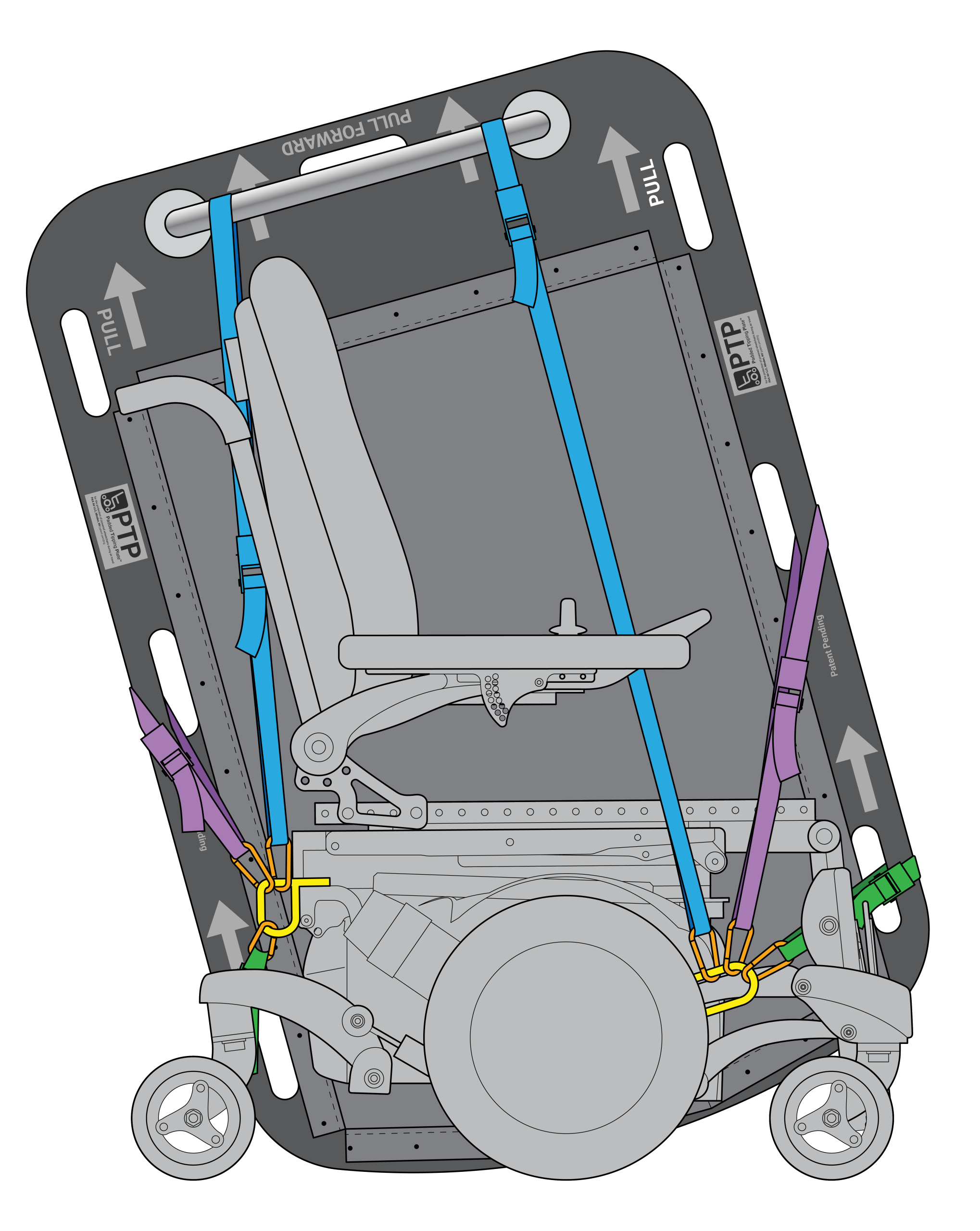
Beneficial Designs has designed a solution to provide securement, protection, and maneuverability for powered wheelchairs that must be tipped on their side to fit into aircraft cargo holds. The new Padded Tipping Plate™ (PTP) technology holds onto and supports the strong power base and seat frame structure of a powered wheelchair, enabling the device to be safely tipped onto its side and transported while in the tipped position. Along with the PTP, the strong structure of the chair is capable of bearing the weight of the wheelchair while tipped on its side.
batteries
Installed batteries are also able to be tipped on their sides, as wheelchair batteries are tested in all orientations. As long as non-spillable batteries are installed in a powered wheelchair (as required by RESNA and IATA), the wheelchair, along with installed batteries, may safely be tipped on its side using the PTP. Non-spillable batteries meeting IATA requirements are tested in all orientations enabling them to be tipped. Even if non-spillable batteries have been installed by the user, these batteries may be removed according to DOT requirements (49 CFR 175.10(a)(16)(iv)) and the wheelchair tipped with a PTP.
tested
Testing at an accredited wheelchair test lab has validated this new device as an effective technology to protect and safely handle heavy powered wheelchairs tipped on their sides during air travel. This system has also been successfully used to transport a 440 lb. powered wheelchair into and out of three Boeing 737s and an Airbus A319. The powered wheelchair remained safely tipped on the Padded Tipping Plate™ during transit throughout the airport and loading, flight, and unloading for each 737 flight.
secured
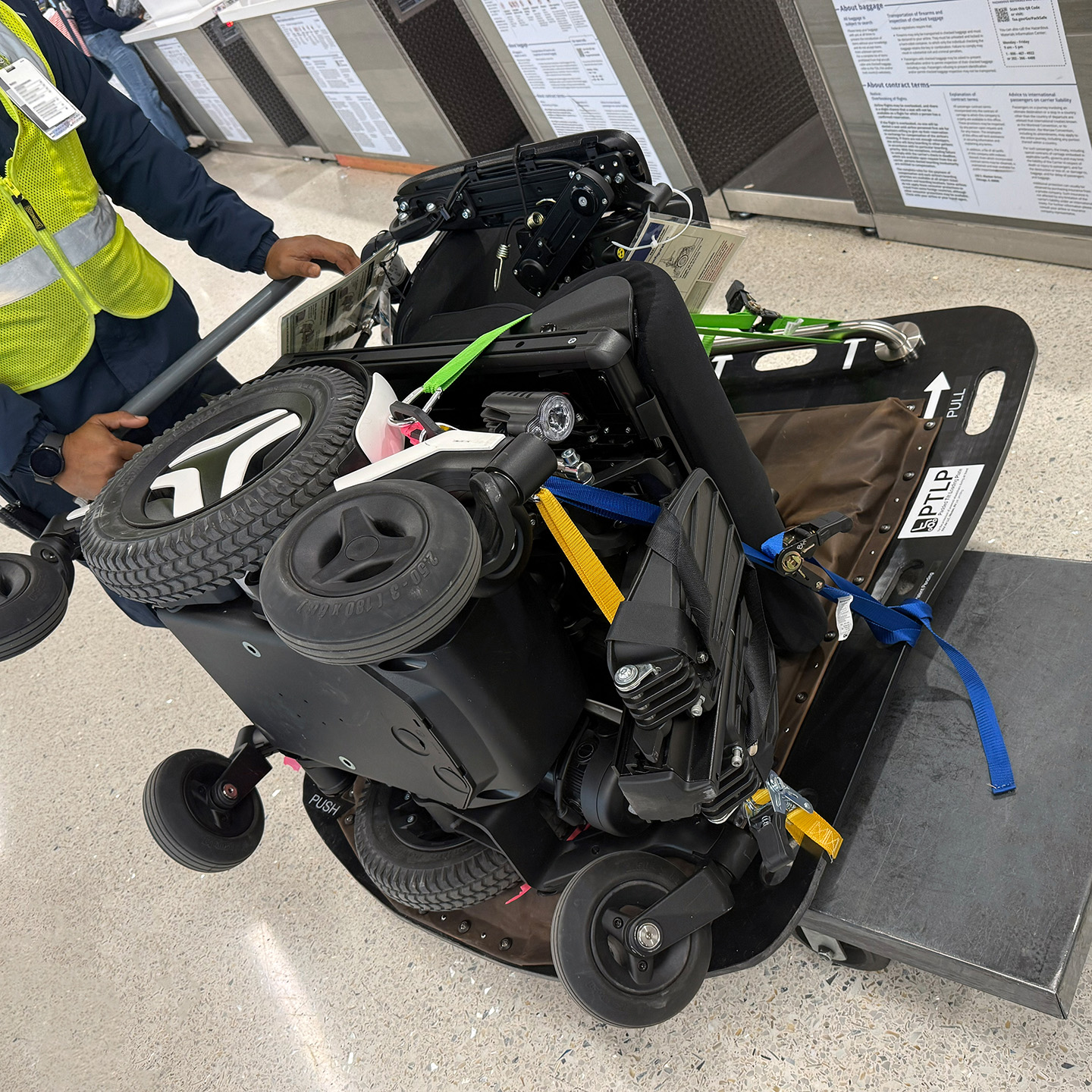
The flexible Padded Tipping Plate™ is strapped and secured to the side of the powered wheelchair opposite the joystick. One person can then safely tip the heavy PTP and wheelchair package. High-tech padding provides cushioning between the Padded Tipping Plate™ and the powered wheelchair, distributing the weight of the wheelchair and protecting the drive wheel, frame, arm support, and back support while tipped. The sides and front of the Padded Tipping Plate™ flex upwards off the ground, creating a movable tray that facilitates safe and easy sliding and turning over uneven surfaces.
loading safely
After being transferred to the belt loader, whether manually or by lift, the package easily transitions across the gap between the belt loader and the cargo door and into the cargo hold. The moving belt helps to move the device, while ground crew can push on the base of the wheelchair and pull on the grab bar at the front of the tipped package.
Once inside the aircraft, the package can then be rotated for positioning and securement, using the Padded Tipping Plate™ hand holds or straps. Using the Padded Tipping Plate™, ground crew will no longer have to handle parts of a powered wheelchair that are not designed to move the weight of the device.
unloading safely
The unloading process is similar as the package transitions onto the belt loader, where it descends and is then transferred to a lift or into a baggage trolly. When delivered to the owner, the Padded Tipping Plate™ and wheelchair package are easily tipped upright for disassembly and preparation of the wheelchair for use.
moving forward
If you would be willing to have your powered wheelchair protected and tipped in this manner in order to fly on a Boeing 737 aircraft, we would like to hear from you. The air carriers have not yet started adopting this new process. We have now rigorously tested three powered wheelchairs from several different manufactures and the Padded Tipping Plate™ has successfully protected all three devices. Damage to tipped powered wheelchairs during air travel occurs because of inadequate and inefficient procedures. Powered wheelchairs are strong enough to be transported on their sides during air travel when properly secured to and handled with a Padded Tipping Plate™.
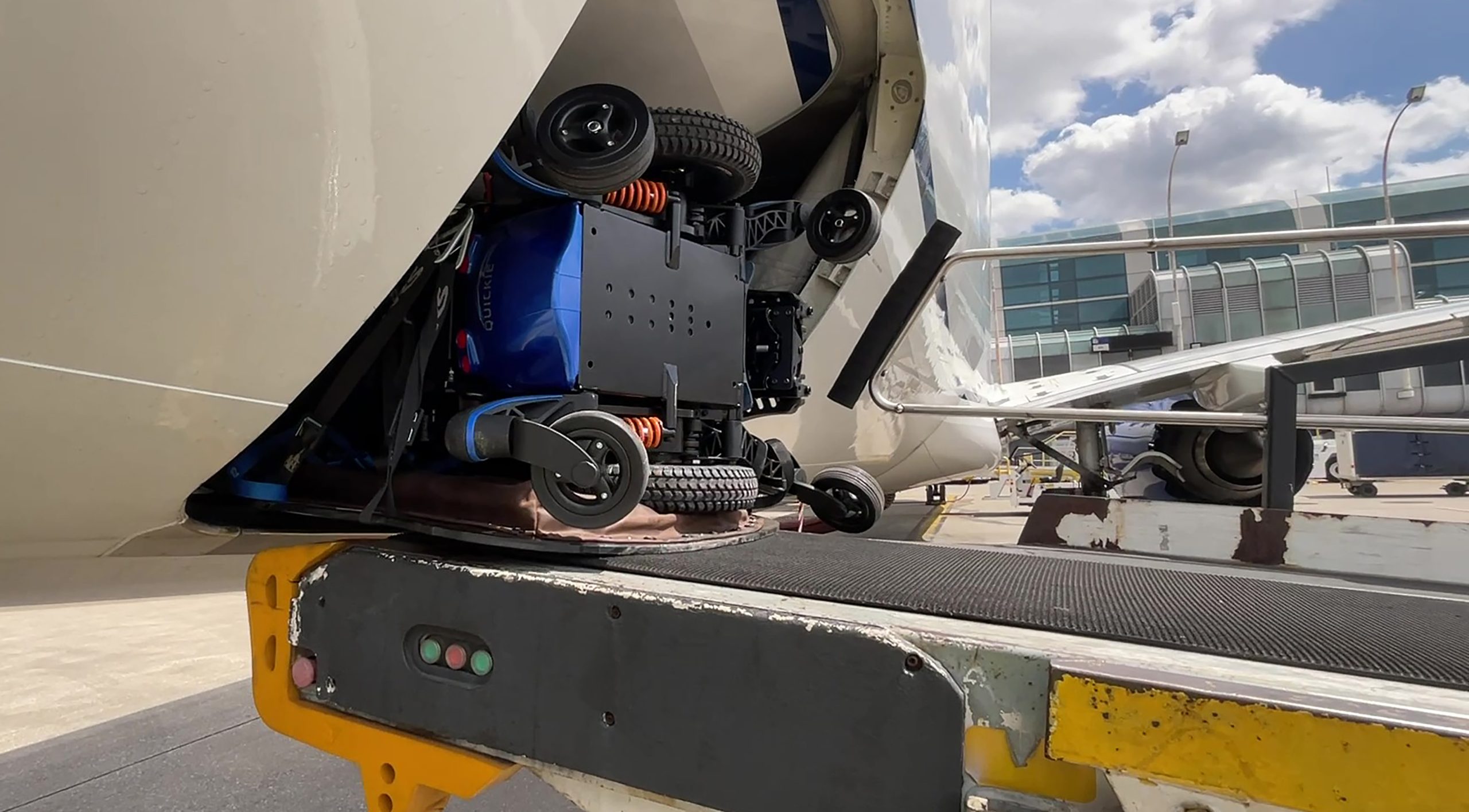
As airlines begin to adopt the Padded Tipping Plate™, access to safe air travel will increase for passengers who require the use of a powered wheelchair. In addition, ground crew will be able to more efficiently and successfully load and unload powered wheelchairs. Please contact Beneficial Designs for more information. We urge you to spread the word and ask for this technology to be used so you can continue to travel on flights using 737 aircraft !